Monday, October 29, 2018

Wisconsin Trapping Season 2018-2019

This year is starting off very slow.  This first week of trapping was during the full moon, which is notorious for throwing off regular animal patterns, making the traps that I set on sign last week almost non-existent.  I'm confident though that this season will be my BEST EVER, so stay tuned.  This season, I have a fisher and an otter tag to be filled, as well as thousands of new private property to trap after December so while I may start slow, I'm hopefully I'll make up for it in the late season.  See you down the line....


My first check of the season was this nice badger in a coyote set today, 10/21.  Badgers do not have a harvesting season here in Wisconsin due to being the state mascot, but with their populations increasing and the damage that they cause to farmers, we will hopefully have them on the lottery tag system like fisher and bobcat in the near future.  This badger was released unharmed but the mess he left behind was quite a challenge to remake!

No automatic alt text available.
I remake the set by simply re-setting the trap in the middle of the moat, in hopes that because of the huge amount of destruction, something would investigate the center.  There are also traps outside the circle off camera in case the crater deters a shy coyote.


I caught this beautiful cat on Sat. 10/27, in the EXACT same spot that I caught my harvested bobcat last year, on EXACTLY the same date one year ago!!  This is a coyote and fox hotspot though, so I cannot pull this trap, but since I don't have a tag this season, this cat was released unharmed.  You can see in the photos that this cat's paw is held tightly in the trap but not enough to cause harm, and that he is simply held in a pair of handcuffs.  Using a sheet of plywood as a shield, I popped the trap open and he went off to kill more of the neighbor's peacocks, unfortunately.  Bobcats are abundant in WI but unfortunately it does take a long time to draw a tag, and the average person waits 6-10 years for one harvest tag, though I've heard some guys waiting 12 years.


 I filled my fisher tag this morning, 10/29, which was a pleasant surprise because I usually end up going atleast a month before I connect on fisher.  This huge dark male was caught in a 160 cage cubby with a beaver skull in the back for bait and some Apocalypse Long Call Lure by Southern Snares and Supply on the tree.  Fisher are very abundant here but you still need to draw a tag, which takes on average for my zone, 2-3 years.  


These animals are the most efficient predators in the state of Wisconsin, as evident by their strong legs, long/sharp claws, powerful jaws and sharp teeth, and their ability to hunt both on the ground and in trees.  That long tail helps keep them balanced like a monkey while they jump tree to tree raiding bird and squirrel nests and I've witnessed this hunting several times myself while out turkey hunting in the spring.


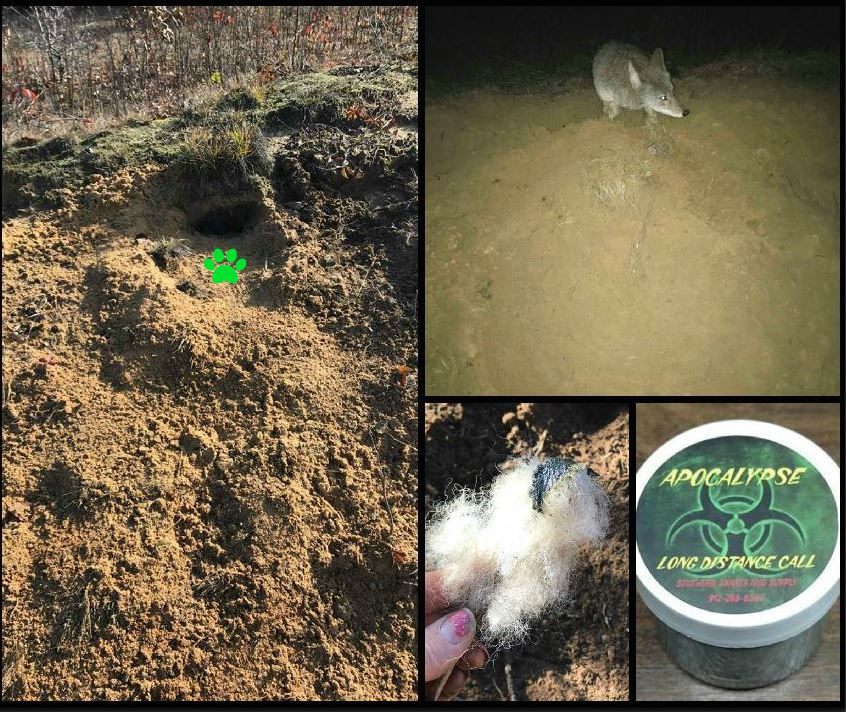
Well it only took 10 days of the season to catch a canine but I finally got a coyote in my truck!  This coyote looks small, but it was actually an old male whose teeth were dark yellow and very worn down.  He was caught in this mock den set that I made using Apocalypse call lure on some of Marble's underfur from when I brushed him this spring, that's it, nothing more!


I caught the world's largest badger this morning.  This old warrior must have been over 30 pounds; I've never actually held a dead badger to be able to weigh it since we have to release all badger in Wisconsin due to no season, however just by judging coon that I've caught, I estimated his weight.  He ruined a very good coyote set that I had on this hill but it was still a cool experience.  I released him with my plywood shield and he slowly bumbled off into the darkness.


This photo shows how quick, easy, and effective using a plywood shield is for releasing animals.  There is a hole cut out on the bottom of the wood; the track goes on one side and the animal on the other.  You can add handles or have another person hold the board, but because I'm usually by myself, I just balance the board against my shoulder as I bend down and pop the trap off quickly.


Caught this nice tom in a cable restraint.  First cabled cat, 2nd cat released for the season, and my 11th overall bobcat in my trapping lifetime.
Two days later, caught this female bobcat in a foothold. 3rd cat released this season, 12th lifetime cat. 


Getting some red fox this year, all in cable restraints so far, which is really exciting for me because I don't usually get a chance to catch alot of red fox due to bobcats, wolves, and coyotes.


And another big male bobcat today, released due to no tag. 5th bobcat this season, 13th bobcat lifetime.  You can watch the release by click this link to go to my youtube video:  Releasing a Bobcat Using a Tote

Finally caught a coyote; this female was in heat.  My dog Marbles was peeing all over every tree in the area.  This spot will be really good to catch a male in the future.

Another female in heat a couple days later.

Traps are so humane and harmless that most animals are curled up sleeping when we check traps.


Weird snub-nosed coyote, after skinning it turned out her skull had a weird underbite and she had been hit by a car in the back end, so her joints were full of infection.


Yep, you guessed it, another big bobcat.  6th bobcat this season, 14th bobcat lifetime.  Released yet again due to no tag.  Held securely in a 1x19 cable restraint made by Southern Snares.


The following pictures are stillshots from the release video.

You can watch the release video here: https://www.youtube.com/watch?v=u44UTwdqOT0&t=24s

My trapping partner Loren.  Loren is paralyzed from the chest down, but that doesn't stop him from trapping all winter.  We just make our sets so they can be checked from a vehicle.  Loren had a bobcat tag earlier in the season, but it ended Christmas day, so while he was excited to see this cat, it was bittersweet since he worked so hard to try to get one just a month earlier.  Stay tuned for a future article about his entire season and the challenges he faced.


This was actually a double catch; you can see the catch circle behind the fox.  I caught a coyote as well but the coyote was so strong that he broke the cable and set himself free.
I've always wanted a fox mount, and this big male was so beautiful, I'm going to keep him to look back on for years to come.

Another female in heat held securely in a 1x19 cable restraint made by Southern Snares.


Friday, September 14, 2018

Wisconsin Cable Restraints: The Basics


Using cable restraints in Wisconsin requires alot of studying and memorizing specific rules and regulations.  For the first couple years of using cable restraints, I suggest having your regulation book right next to you so you can be sure you aren't missing anything, and who knows, you might recognize someone on the cover this year ;)

There are many, many different cable restraint specifications that you need to know.  I will list the "basics", meaning if you came to this blog for a simple question, I'll probably answer it in this post.  For more in depth answers, check out the regs.

The first and most important tip that I can give you is that you should not be trying to make your own cable restraints if you are brand new to cables or trapping.  In Wisconsin, the laws are too strict for you to take a chance.  So I suggest buying WISCONSIN LEGAL cable restraints from a reputable cable maker.  I personally have seen some of the "big suppliers" who claim they have WI Legal cable restraints and they still have the wrong lock, or wrong length, so triple check your cables before setting them!!

The cables that I personally use can be found at here: Southern Snares & Supply, and Brian, the owner, has been working with me for many years so he is very well-versed on Wisconsin regulations and the most recent changes to cable restraints as well.

One month's catch using Southern Snares cable restraints

Here are some of the basics for Wisconsin legal cable restraints:
  • Cable must be 7x7, 7x19, or 1x19.
  • Cable must be 3/32 or larger.
  • Cable must include a max loop stop and deer stop.
  • Cable must have a relaxing reverse-bend washer lock.
  • Cable must be atleast 5 feet long but no longer than 7 feet.
  • Cable must have atleast ONE swivel, but more are better.
  • Cable must have a breakaway device for 285 pounds or 350 pounds, your choice.
  • Cable must be anchored, no drags allowed!
  • Cable must not entangle in debris, so no fences, posts, etc.
  • Entanglement is any rooted, wooded vegetation w/ a diameter greater than 1/2 inch.
  • Some type of support wire, usually 9 ga
A basic cable set up in the field.
My set up:
Prior to the start of each season, which runs Dec. 1-Feb. 15, I will prep my cable restraints.  While still coiled up, I spray a light layer of tan spray paint over my cables.  I do not boil in baking soda.  Baking soda will rust the inner cables and I feel it weakens my cable, making them more susceptible to breaks and chewouts.  Some guys will disagree, this is just my story and I'm sticking to it.


Once dry, I take one cable restraint, add a quick link to the bottom swivel, attach a wolf fang earth anchor, add my trap tag, then put each set in a gallon ziplock freezer bag.  This keeps everything organized and you are ready to go at the start of each day.  If you find a new property, you have everything you need to set in that moment.  If you want to walk across a huge field to set 5 or 6, you only need to carry 5 or 6 gallon bags.  And dozens fit perfectly in a 5 gallon bucket.


To view me making a cable restraint set, please click on this youtube video (it was too large to load in this blog post): https://www.youtube.com/watch?v=hik2umcsG00


Here are some catch pictures that I wanted to show so you can visualized what the catch circle will look like.  Notice how it is HUGE compared to a foothold, and how the area is tore up and will not be reusable usually for another cable.  This circle is what you need to visualize when making your cable set.  If you have any entanglement in the catch circle, it would be an illegal set.


Here are some "before and after" pictures so you can see the original set that I made, then the catch afterwards.  You are targeting the neck when setting your cable for coyotes.  I personally make a 9 inch loop, 9 inches off the ground.  Adding a chin lift will draw their face upwards and off the trail, which helps guide them into the loop.  Note in these pictures how OBVIOUS the cables look to us, and you might think, how could a coyote ever stick it's head in there??!  But at night, these cables blend in and they go right through them without thinking a thing is wrong.


Notice in this picture, I had a previous chewout.  A chewout is when the coyote gets caught, sits down and just bites through the cable.  It happens, it doesn't do any harm to the coyote, but you check your set in the morning and see the cable bitten through, and it's a frustrating experience.  Using 7x7 cable, you are more likely to get chewouts.  Switching to 1x19 will increase your odds of holding them there until morning.


Here are a few videos that I wanted to show you what it's like to actually walk up on a caught coyote.  They are powerful animals, and because we can't use snares in Wisconsin, we have to keep them alive all night, meaning they are jumping and fighting the cable when you get there.  Having your dispatch gun loaded and ready is a good thing to do because if this cable breaks, you still could have a second or two to fire off a round.


After you catch a coyote, the cable restraint is not able to be used again.  You can salvage some parts like the swivels and support collars, but they are cheap enough that you can simply toss them.

Good luck, and if this blog helped you in any way, please feel free to comment with your success!


Thursday, August 9, 2018

Waxed Dirt Making for Cold Weather Canine Trapping: Solar Method


This article tells you how to make waxed dirt for weatherproofing your canine sets in cold states where the ground freezes using the solar method in the summer months.

You can order flake wax here: https://www.southernsnares.com/products/flaked-wax

Summer waxed dirt making is ideal on any day over 85 degrees with no rain in the forecast and low humidity.

Sift dirt into your heating container, this can be a black planter like I have pictured, your own wooden cradle, or a tarp on some plywood. 

Stir your sifted dirt every hour until it is completely dry.  This is the most important step.  There cannot be any moisture in your dirt prior to waxing, or you will be sealing in moisture, which will result in mildew and freezing.  You can tell your dirt is dried when you stir it around and there is no color change.

Once dry, add a thin layer of flake wax to the top, slightly covering the dirt.  Do not mix.

Allow this layer to melt and seep into the dirt.  Once melted, it will appear wet.


Stir this first round of “wet” dirt around real good.

Even out and add a second layer of flake wax to the top.

A good rule of thumb is to use 2 cups of wax for every 1 gallon of sifted, dry dirt.

Once the second layer of wax is completely melted, you can stir that around real good.

You’ll know you are done when your container of dirt entirely appears “wet”.

Allow to cool before storing or you will end up with a solid brick of waxed dirt.  Be sure not to “seal” your storage container, so that moisture and heat can escape, or you will get mildew and then all your waxed dirt will smell like a wet towel that sat on the floor for a week.

I also recommend drying a batch of regular peat moss while you do this process.  Once your waxed dirt is complete and cooled down for storage, I add equal parts waxed dirt with dry peat moss and stir together.  For example, I’ll put a 5 gallon bucket of waxed dirt into my storage container followed by a 5 gallon bucket of dry peat moss and stir it like I’m churning butter.  The peat will act as a filler to help stretch out your precious waxed dirt gold throughout the season but will also help wick away rain or water at your set.


If you are wondering how much waxed dirt you should make, a good guideline is 1 gallon of waxed dirt per trap.  So if you run 50 traps per season, make 50 gallons of waxed dirt.  Also, I like to tell people to double that number that they come up with.  Then you might have enough to last.  You never know if deer will set your trap off 5 times, or you’ll catch 19 skunks before that first coyote, so you want to have extra on hand.

If you did not do this process ahead of time and it’s mid-January and you are wondering what you should do now, please read my waxed dirt article for procrastinators: http://skyegoode.blogspot.com/2018/01/how-to-make-waxed-dirt-for-winter.html

Monday, April 9, 2018

The Importance of Using Technology FOR the Future of Hunting & Trapping


The Importance of Using Technology FOR the Future of Hunting & Trapping

            As a very active member of social media, I hear more often than not that I am “risking the future of hunting/trapping by posting pictures and videos on social media”.  This is a statement that I wholeheartedly disagree with and will discuss why in this article. 

            It’s no secret that there is a vast gap between the last generation before the internet was created, and the generations after.  The fact remains that technology is not going away, so people need to embrace change and see the glass half full.  It is true that a lot of the younger generations are growing up with limited social interactions and more social media, but if we want a future for our past heritages such as fishing, hunting, and trapping, then we need to be creative on how to introduce youth to these sports when they are constantly plugged in.

            My solution: Post on social media. Currently, I am active on Facebook, Twitter, Instagram, Youtube, Snapchat, and I have my own blog.  On all these sites, especially during the trapping season, I am live streaming, posting pictures and videos, and writing articles about my adventures in the outdoors.  The fact is, the more disconnected that people get from nature, the outdoors, and where their food comes from, the less likely they are to engage in those activities.  If our children are growing up being exposed to myths such as “hunting is cruel”, “animals are skinned alive”, etc., and never see the alternative, factual evidence, then they may grow up believing the propaganda. 
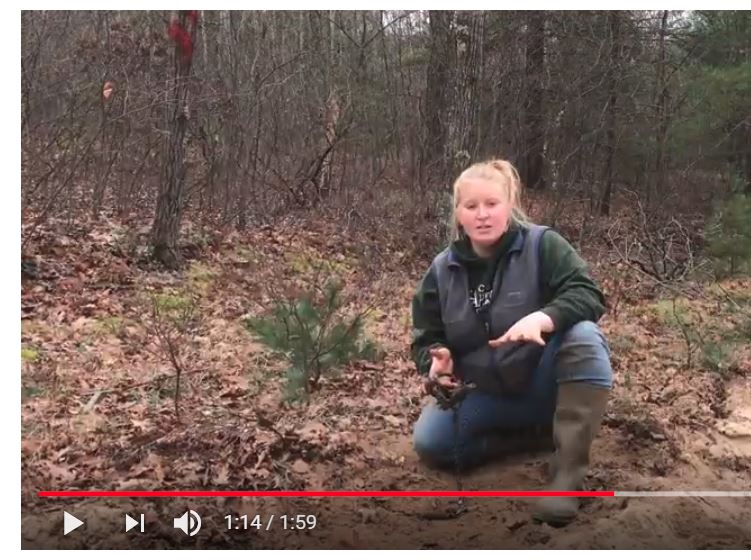
A video still from a "hand-in-trap" video that the author published, explaining how traps hold the animal comfortably, and that traps "hold not hurt".

            Anti-hunting and anti-trapping groups are EXTREMELY active on the internet, even when they are spewing misguided and conjured up hoopla.  They are always staging photos to benefit their agendas, and use their pages and petitions to tug at the heartstrings of people on the internet.  We know our grandparents and parents are the smallest demographic of people on the internet, so who are these groups targeting? The answer is, our youth.  Ages 12-18 are the targeted audience.  No matter what side you are on to begin with, evidence shows that what you are exposed to in this age range has a significant role on what you grow up to be.  If teenagers are infiltrated with anti-hunting messages, they are more likely to grow up wanting to protest hunting and wildlife conservation and management.

Photo shows a bobcat held comfortably in a trap.
 

            I have quite a following on social media, and many of those followers have no idea about the facts of hunting or trapping.  I can’t count the number of times folks have told me that they are glad I posted a video showing myself putting my hand in one of my traps, because they thought traps “broke bones and harmed animals”.  I’ve had many people tell me that they didn’t know that we had otter, fisher, bobcats, etc. in Wisconsin until they saw me post pictures of releasing several from my traps.  I even had someone once tell me that they didn’t know wild turkeys strutted until they watched one of my hunting videos. 

            I really feel that part of the reason a person would oppose increasing bobcat tags, or having a badger harvest season, or passing a wolf hunting season, is that they truly believe that these animals are “endangered, threatened, and rare”.  They may have never seen any evidence of those animals in Wisconsin for their entire lives.  I recently posted a video of a badger walking along the road and many people were shocked that we had badger in Wisconsin….Wisconsin, the Bucky state.  I’ve released several badger in the past couple trapping seasons, I’ve had badger on my trail cameras, I’ve seen badger roadkills more times that I can count, and I’ve seen badgers and/or badger dens with offspring many times.  So to me, badgers are as common as any other furbearer.  I’ve had more interactions with badger than I have with grey fox, yet nobody thinks grey fox season should end.  Exposing people to what we do is the best way to inform them of facts.  Making a statement like, “You shouldn’t post what you do on social media” is as bad for hunting as any anti group petition.

Badger caught and released unharmed by the author.


            I feel that posting responsibly and frequently on social media is the best way to introduce youth to our beloved sports.  Showing photograph evidence that refutes the myths that anti groups like TrapFree Wisconsin, Wolves of Douglas County/Wolf Patrol, Humane Society of the US, and PETA are trying to convince people about is the best way to combat these groups.  These groups do not care for the animals; they are formed for selfish reasons that include attention, money, and to be in the spotlight.  These groups are so disconnected from wildlife that they would not be able to tell you a coyote track from a bear track.  These groups are the same ones that tell the general public that wolves are endangered, when the facts show that wolf populations are over triple the sustainable numbers. 

            Now you may know the obvious answer to what we shouldn’t post on social media, but what should we be posting? Information is the best content to post, and often.    I run several sites, groups, pages, and accounts and my belief is that posting answers to common questions is the best way to help others understand what we do.  Let the public know when the next hunter safety or trapper ed class is.  Tell them about upcoming changes to laws that would impact them.  Inform them about the changes that anti groups are trying to push.  Let them know about events in the area that may help them learn about tracking, scouting, shooting, and anything outdoors.  Post pictures of your harvests, tracks, animal sign, traps, bows/guns, trail camera photos, buck rubs and scrapes, etc. 
Photo showing a coyote that was caught in a foothold trap.  Evidence that traps do not harm, break bones, etc.  Can you even tell which foot was in the trap?


            The more we hide what we do, the less likely that youth will take an interest in our “secret” world.  As long as we are posting respectful, responsible content, then we have nothing to hide.  We all know that in every group, no matter the industry, there are rotten eggs.  We have rotten eggs in the hunting community who poach or trespass, we have rotten eggs in the trapping community who use old traps that are not comfortable for the animal, there are rotten eggs in hiking or camping groups who litter, destroy trees/foliage, etc.  Every group has an outlier but the majority of people are good at heart, and we need to embrace what we do and be proud. 

The author and her collie Marbles, with their 2017-2018 "end of the line" catch.


Tuesday, January 16, 2018

How to Make Waxed Dirt for Winter Trapping

This article tells you how to make waxed dirt when you are in the dead of winter and need to make it in the oven.   Please refer to the summer solar method article if you aren't a procrastinator.