Showing posts with label archery. Show all posts

Monday, October 6, 2014

Doe Down! Second deer of the 2014 WI archery season!

After being lucky enough to fill my buck tag on opening weekend, I took this big mama doe last night from the same stand. 

 No glamour shots here, as this doe took me to hell and back tracking just spots of blood every few yards or so with a cell phone light through the swamp.  I didn't recover her until 11pm, but she had only gone about 60 yards.

 I have 2 more doe tags for bow, gun season, 3 fall turkey tags, and a fisher tag left for the 2014 hunting season!!


Monday, September 15, 2014

The Shortest Hunt of My Life

This story will not be like my previous, longwinded anecdotes that encompass countless hours in the stand and details that boggle the brain.  This is not the story of the Pope & Young monster that I worked my butt off all season to shoot.  This is the story of my 1 hour deer hunt that opened and closed my 2014 bow season in a matter of minutes. 
            Over the weekend, I headed out on the back of the Harley for the last and coldest ride of the season up to Tomahawk, WI to enjoy “Mini Sturgis”, while the rest of the state was taking to a tree stand for the Wisconsin bow opener.  On Sunday, after driving back 4 hours and returning home at 3pm, I thought I would sneak out to the stand for a couple hours, since I would not get to hunt again until the following weekend.  I was full of makeup, hairspray, perfume, and motorcycle exhaust.  I didn’t get a chance to shower, and hadn’t really showered in days.  I grabbed my Mossy Oak camo from my Watson Airlock bag that I washed the year before, and shot 3 field points into my target for my first three shots of the year; my sight hadn’t shifted from the previous season so I was good to go.
            I was dropped off at the woods at 4:02 so I wouldn’t leave a vehicle behind because the deer sometimes come from across the dirt road.  Walking into my stand, I kicked up 3 flags.  I climbed up my treestand and realized that I forgot a bow hanger and my video camera.  The mosquitoes were AWFUL.  I usually hunt barefoot but was forced to put some green socks on because the mosquitoes were eating me alive.  Nearly 15 minutes later, a doe with a buck fawn came into my food plot; I assumed these were some of the flags I jumped just minutes before.  I was eager to harvest a doe, but this one had gotten pregnant as a yearling and given birth to a buck fawn this spring, so I knew she was good breeding stock to keep in the herd, plus I could never live with myself if I killed a doe with her baby as witness.
            As I watched these two graze among the clover, I noticed they both perked up to something behind me.  As they meandered off, I saw a deer coming in quick over my left shoulder.  I saw it was an 8 pointer, young, seemingly a 2 year old. 

I took a few pictures on my phone, thinking, “I’ll post this to Facebook, bragging how I pass up this ‘good buck’”.  But then I quickly realized, What!? This is a nice deer, a great shot opportunity (broadside at 15 yards), and the fact that I drew a fisher tag for this fall season was the most important thing in the world to me right now.  If I pass this buck, I’ll really regret it in November when I’m struggling to find any deer that would qualify as a buck.  To me, an unfilled tag is the ultimate defeat. 
At 5:06, after giving it a split-second thought, I drew back on this deer.  I shoot a 1997 Vector III PSE Nova youth model, AKA: The Noisiest Bow Ever Made.  The buck jumped back from 15 yards broadside to 30 yards straight on.  I’m a confident shooter so I took the shot to the center of the chest.  The arrow hit slightly to the left, entering his chest and exiting under the right shoulder.  The buck took off, ran 30 yards, and I heard him topple over.  I let him sit an hour to be sure since he was out of my eyesight, then got down from the tree.  I started to track him and found blood sprayed all over the leaves and high on the trees, confirming the shot placement.  I only took a few steps when I was able to see him laying over yonder. 


One hour and 4 minutes.  My 2014 archery season consisted of one hour and 4 minutes.  I’m aware that I still have doe tags to be filled, and gun season will be upon me quickly, but it’s still bittersweet that I won’t be in the stand with my bow during the rut, covered in doe pee, making mocking scrapes, and calling my best series on the grunter. 


Most of you reading this post are thinking, “I would have let him grow another year”.  Good for you.  I, however, have a lot of life changes on my plate, limiting the number of days that I have in the stand this year, so I vowed that the first 8 or better I saw this year was getting a shot.  Next year, I definitely won’t be taking a buck in the early season unless it’s a booner or in velvet because I’m already SO incredibly bored.  Luckily, I have a several turkey tags and some doe tags left in my pocket!  On a brighter note, as I mentioned before, I did draw a fisher tag, so come October I’ll be putting all my time, money, and effort into making sure that tag does not go unfilled.


Thursday, July 24, 2014

2013 Wisconsin Archery Buck

THE spot, complete with scent wicks and mock scrapes.
For the second fall in a row, I had the opportunity to bowhunt on a prime spot in Dunn County, WI, owned by a man who I consider my spiritual mentor, Bill. The land had great meaning to me; I had hunted on it year-round including shed hunting, spring turkey hunting, and bowhunting.  The previous fall I focused mainly on hunting the eastern oak ridge, where the birds and deer had hit the acorns religiously.  This year, something told me that the rut would be strong, and that hunting in a stand bordering the bedding area would be beneficial. Throughout the season, I encountered more shooter bucks than I ever have before in one season.  Opening weekend, I passed on a nice 7 pointer that appeared to be a young buck, and came in ready to fight to a grunt series.  I had several encounters with shooter bucks that just didn't present a shot, came in after shooting light, or I couldn't pull them off the doe they were following.  As the weeks progressed, I continued to pass on young bucks that will be trophies next year, but just weren't worth putting my tag on this year. 

After logging over 105 hours in the stand since opening morning, mid-November was starting to heat up and I had an opportunity to take a wallhanger.  As he came in on the trail 35 yards in front of me, not 5 minutes after a hot doe walked through, I knew he was going to give me a good broadside, quartering away shot.  35 yards was a bit out of my range, but sometimes you have to take opportunities as they come and step outside your comfort zone.  I did not have a pin set for more than 30 yards, and even through my bleats the buck would not stop, but I aimed in the vitals and took the shot.  I missed just under his belly and he trotted off; not terribly alarmed but gave me a few snort wheezes and meandered off into the brush.  I was crushed, defeated,kicking myself for screwing up a shot on a nice buck.  I cried all night and called a few friends to talk me through it.  They told me stories of their misses over the years and it helped me realize that if you are truly a hunter, missing is just part of the game. It’s like a professional baseball player batting 1.000, it’s nearly impossible.  Though we all want every shot to connect perfectly, missing is just as important.  I learned that I need not take shots I am not generally comfortable with, and that stopping a deer on the move is very important when archery hunting.  I vowed to everyone who heard of the miss that I would never hunt again, but I continued to hunt the rut.  I had seen a good amount of deer throughout the week; the corn was being cut across the road, the rut was in the full swing, and high winds made the deer constantly on the move at all hours of the day.  One week after my big miss, I had the opportunity to complete a full day sit.
He was a frequent nocturnal visitor to THE spot.

 On Thursday, November 14th, I went out in the stand at around 9 am and sat all day.  It was the peak of the rut, so I periodically called with a series of estrus bleats and low grunts.  Around 1pm, a nice buck walked from across the road, grunting in response to my calls.  He stayed about 85 yards in front of me, and walked down into the bedding area, which was a low-lying swamp just West of the oaks I was sitting in.  He had his head to the ground the whole time, so I figured he was tending a hot doe and would be impossible to pull in my direction. Throughout the afternoon, I kept with the same calling series, mostly out of habit and a bit out of boredom. At some point in the afternoon, I heard a couple deer walk from the bedding area towards the feeding area, but they kept in the thick brush so only their feet were spotted.  I made my last series of doe bleats in tandem with a chasing grunt call.  In the last 15 minutes of shooting light, I spotted a buck coming from the feeding area and making his way right at my stand, nose to the ground, with a quick pace.

He was walking the exact trail that the bruiser from a week before had walked, though it was not the same buck.  I grabbed my bow, nocked my release, and with a second to spare, he walked right into my shooting lane.  This time, my instincts told me to not make the same mistake twice, so I let out the loudest bleat I could and accounted for the extra yardage on my pin.  The buck stopped dead in his tracks, broadside but quartering to, so I let the arrow fly.  It was a solid hit, slightly back; one of those “knocked the wind out of him” kind of hits.  He buckled up and labored to take off running.  He ran straight for the bedding area, and I lost sight of him around 80 yards out-exactly where I spotted the buck at 1 pm that day.  Still shaking from the adrenaline, I got down from my stand and immediately checked the trail camera that had been pointed to take pictures of that deer trail, but it hadn't captured a picture of the shot.  I went to the hit spot and saw his running track, hair, and my arrow broke in half,with the broadhead end laying 10 yards from the hit.  It was covered in dark, chunky blood and smelled like the intestinal track.  It was just about dark now and I was running out of light.  I followed his running track for about 15 yards and did not have any blood, so I put my coat where I found the broadhead and headed back out to the road. 
Bill happened to be turkey hunting this same night, and was sitting due West in a pine plantation about 125 yards from my stand.  I waited on the road and when he came out, told him I connected on a buck. He said he did not hear any crashing close to dark, so with myself being on the East end, the paved road being the South end, and Bill on the West end,I was able to pinpoint that the buck was somewhere in that 125 yard rectangle of thick bedding area.   After conversing with Bill and telling him every detail of the hunt, we both agreed that with the shot being back and the cool temperatures, it was best to let the deer sit overnight and resume tracking at the day’s first light.

            It was one very sleepless night.  I called a few of my closest comrades to ask for advice.  My cousin Adam assured me that because of the shot being back, and the fact that I immediately backed out and did not jump the deer from his first bed, if given a few hours the deer would surely die overnight.  A good friend and trapping legend, Duane, completely agreed and suggested that I use my sleepless hours to prepare for the morning’s track.  Duane’s first tip was to fill a spray bottle with Hydrogen Peroxide and a food coloring such as blue.  Upon coming into contact with blood or other bodily fluids, Hydrogen Peroxide will foam up, leaving behind a blue tinted layer of bubbles to facilitate directional tracking.  Duane also suggested bringing along a roll of toilet paper to hang on each and every blood drop, track, hair, turned overleaf.  If tracking gets difficult, one can turn around and look at the pattern of paper hanging on the trail to see if the deer started taking a particular direction, plus, it’s biodegradable so clean up is easy.  Both of these tips proved to be very beneficial on the next morning.

About an hour before the sun came up, I went to seek the advice and guidance of Bill, who happened to be working the overnight shift at our office.  He helped me walk through the events that took place the night before, and assured me that with patience and attention to detail, my deer would be recovered.  I headed out to the woods and the first thing I did was get back up in my treestand.  I replayed the entire hunt, focused on where I shot and what I remember the deer doing, and paid attention to the landmarks in the area where I last saw the buck before he headed into the thick brush. After I was certain that I memorized every detail, I resumed tracking from the spot where I left my coat.  At first, all I had to go on was his running track.  In combination with the landmarks that I noticed up in my stand, I followed his track for another 20 yards.  At this point I heard something take off in the woods, but it was quiet and fast, so I knew that it couldn't have been my buck, and figured it was probably just another deer that happened to be using that trail. 

At the first point of blood, I found the other half of my arrow with the fletchings covered in blood.  Blood was scarce and the only spots I found were dark droplets of about a dime to quarter sizes.  I was careful and diligent, and hung a piece of toilet paper on every droplet, every scuffed track, and every broken sapling.  About 40 yards into the track job, the blood ceased.  I became frustrated when I entered the swamp opening and saw that his track was not noticeable in the heavy swamp grass.  Remembering the suggestions that Duane gave me, I pulled out my spray bottle of Hydrogen Peroxide and knelt down by the last blood. I sprayed a full 180 degree span on the ground.  Immediately, a leaf about 3 feet from the blood foamed up and told me the direction the buck went it.  I was shocked because if I hadn't had that clue, I would have taken the trail in the opposite direction.  Like many wounded deer do, the buck began circling back to where he had been shot. This leaf did not have any blood on it, but clear juices from the deer's body had dripped out and would have been undetected to the human eye.  I continued on and about another 25 yards into the track job, I heard crows chattering like crazy.  I looked up, and saw my buck lying up against a tree.  The feeling that came over me was indescribable! 

The moment I looked up from last blood!
I walked up to my trophy to see that one of his back hams were torn into. It was very shocking because in the two years of me scouring that land,I had never heard a bark, never cut a track in the mud or snow, and never caught a picture on the many trail cameras I had out of a coyote.  I figured that the animal I kicked up at the beginning of my track job was probably the yote eating my kill.  Many hunters would be angry, but I considered it a way for me to give back to the land. We all play an intricate part of the ecosystem, and the buck presenting me the opportunity to shoot him was no different than me giving the coyote an opportunity to grab a quick snack.  It’s unfortunate that one ham was gone, but it was a meal well-appreciated and I had plenty of meat from the rest of the deer. I also see it as a way to feed the prey that I pursue in the winter months and am currently working hard to call in that coyote that was an important part of my archery kill this fall. 
Coyotes enjoyed a snack just minutes before I found him.

            We all remember every detail of our hunts, but sometimes forget that there are many key players in the game that help us to be the star.  Someone taught me to hunt, someone granted me access to their land, someone helped me with the decision to not push the deer, someone gave me tracking tips and even the crows helped lead me to the recovery.  I think even the miss from the week before played an intricate role in teaching me valuable lessons in resilience and perseverance.  If I would have put down the bow at the moment I missed that deer, I would never have had the amazing opportunity to experience this hunt the way I did.

Damaged G2.


Very happy to harvest this buck with my 13 year old compound bow.  No fancy equipment needed.

First Wisconsin Archery Bear

After 5 years of patiently waiting, I finally drew a kill tag for the 2012 Wisconsin bear season. I quickly learned that filling a hollow log with sweets would not guarantee a bear would come in easily, especially with the acorn season coming up fast. I had started baiting in mid-April and had three primary bait sites that were actively getting hit by many different bears. One site was overtaken by an old sow and her four cubs early on, and she ran off any bear that tried to cross her path, so I had to let that stand run cold. 
My second site was a ground blind on public land in Jackson County, in the heart of wolf country. I had sat there several times, and it was a seasoned bait site that my cousin had used to run dogs, so every bear in the area knew that site was there for years. There were no trees in the swamp site that would hold a stand, so a ground blind was my only option. Opening day I went into the blind and heard something running on the dirt path, but no bear ever came in. When I left the blind and cut my own track in the dirt, there was a huge wolf track right on top of mine, like he was following my scent. Needless to say, I was a little nervous sitting in the ground blind with only a bow during the hunt.
The season started on the first Wednesday in September and I had been hunting almost every day for two weeks, not seeing any bear. I had consistent hits on the baits that were filled with cookies, donuts and sweet syrups in the months preceding. The week of opening season, the acorns had steadily started dropping and getting a bear to hit my baits seemed impossible. I had talked to other bear hunters who reported that they were having baits run untouched all week because the animals were overindulging on acorns. I was getting very discouraged that I was spending countless hours in the stand over a log filled with goodies, when the bears would rather do work to dig through the leaves for nuts than have an easy free meal. 
Finally, on Sunday September 16th, 2012, my time came. I went into my third site; a bait that was setup by my cousin in early August as a last ditch effort to pull some bear off the river and into the public land swamp. As I settled into the hang-on stand, I was almost getting lazy with my hunting since I hadn't had any luck for weeks. I didn’t take a scent-free shower before I went in, I didn't put camo makeup on my feet, and I didn’t wash my clothes that I had been wearing for two weeks. My hair was in a ponytail, still full of hairspray and perfume from the night out on the town before, and I just rubbed some dirt on my face to stop the glare. A few hours in, I was starting to get discouraged. I had trail camera pictures of several big bears that would always come in together at around 4 pm and gorge themselves for a couple hours on the bait site 15 yards down from my stand. It was now 5 pm and I hadn't seen a thing. 
The downfall to bear hunting is that you aren't able to observe other wildlife because everything stays clear of the bear’s buffet. There are no deer, squirrels, or turkey to occupy your attention while you wait for a bruin to come in. I suddenly heard a twig crack over my right shoulder, and slowly turned to the sound. A small bear, maybe 100 lbs., was casually walking into the site. It looked like a small sow, and though any bear is a good bear, I decided it wasn't worth the time and effort that I was putting in to fill my tag.
About an hour after the small cub walked off, I heard more footsteps coming from my left shoulder this time. I turned slowly, and again, a nice sized bear was coming right in for the bait. As I grabbed my bow, nocked an arrow, and clicked in my release, I was prepared to take the big sow that appeared to be about 250 lbs. The first thing I noticed was the white patch on her chest, which in my area, 1 out of 100 bears are said to have a white patch, so that intrigued me even more. She sat down and began licking the peanut butter off the rocks on the bait site, and was facing me straight on. I decided to take her with a shot through the chest and drew back. As soon as I felt the let off and put the pin on her white spot, I caught some movement out of the corner of my left eye. Another bear was coming in and I saw his huge block head right away, letting me know it was a big boar. I let my bow down thinking that I might want to re-evaluate which bear to take. 
The sow with the white patch is on the left; my boar is laying on the right.
He stopped in his tracks, looked me straight on, and began sniffing the air trying to catch my scent. Bear have very poor eyesight and in the darkness of the woods, he was unable to make out what I was, though he was slightly alarmed. Just then, the strangest thing happened. A big doe walked through the site about 40 yards behind the sitting sow and stepped on a stick, making a loud crack through the woods. Since the boar was already weary of the movement he saw in the tree, he took off at a full sprint back into the swamp. My heart sank into my stomach. I thought I had blown the best opportunity I would have at taking a trophy bear. But I realized that the sow was still perfectly content eating sweets on the bait pile, so I continued to hold my position, knowing that if she was happy, the boar had to come back. I was standing barefoot on the metal stand, still holding my bow, not drawn, but in the upright position. Thank goodness for my tree harness or I would have shaken right out of the tree because my muscles were starting to fatigue and adrenaline was pumping through my veins, making my knees weak. I had stood there in that position for what felt like the good part of an hour. Just as I thought he would, the boar came back to the site when he realized the sow was not alarmed, but instead of coming right in, he walked a complete circle around the area, staying about 60 yards out.
I was so proud to take this bear with a bow, just like I had planned!
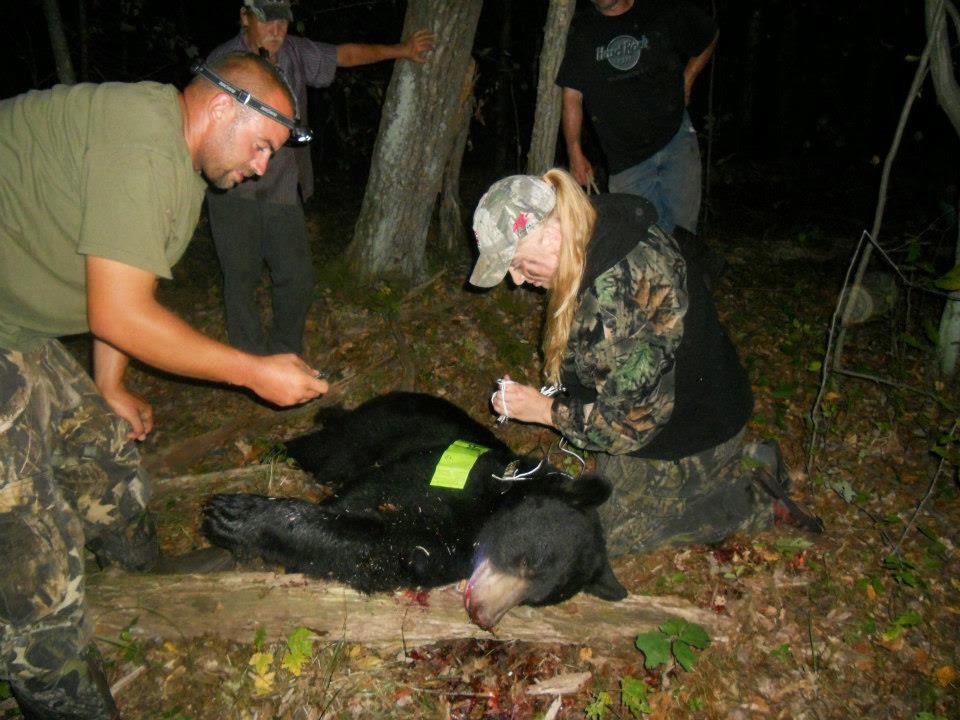
He finally decided it was safe to come in and walked up from behind my right shoulder this time. When he was broadside on my right at 10 yards, and his left leg took a step forward, he stopped and watched me draw back. I took a fraction of a second to put the pin on the quarter size spot I picked out and let the arrow fly. It was a solid THWACK through both lungs and he let out a loud groan like someone had knocked the wind out of him. He barreled through the swamp and I heard him fall over about 60 yards away, with a terrifying death bawl shortly after. I grabbed my phone and called my cousin who was bowhunting a couple miles away and through the heavy breathing and shaking managed to tell him, “I got him, I got a big one, he’s a big one!” The bear was still moaning so loudly that my cousin could hear the death bawl over the phone.


Harvesting a trophy is a family affair!

Once all the family came to help me take care of the bear, we went back into the woods and recovered my arrow that cleanly passed through and was lying right where I shot 
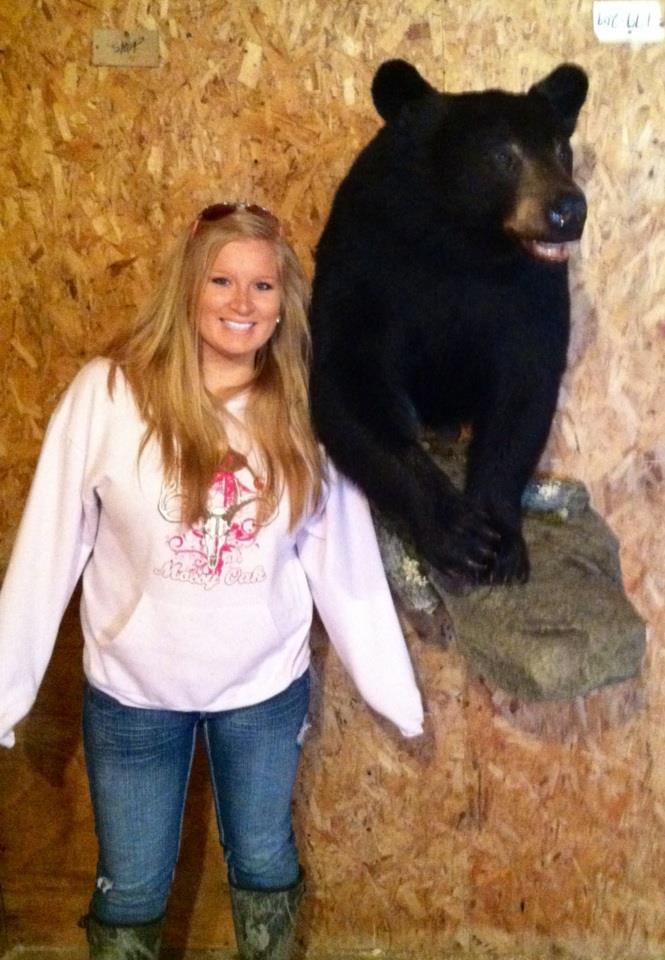
him. There was no need to follow a blood trail, as just a few yards away I could see the black brute lying in the swamp grass. I was proud of myself for sticking out the season and not being discouraged when baiting didn’t work. I was unable to get an exact weight on the bear, but it was estimated to be about 300 lbs. The skull green scored at 18 inches, so I missed Pope & Young by a fraction of an inch. I had it half mounted and he hangs in my living room, posed in the exact position I shot him, head turned to the left, his shoulder forward taking that step. 

The skull dried to 17 7/8 inches; missing P&Y by 1/8 inch!
I relive the hunt every time I walk past the mount and my heart pumps just as hard as moment I shot him. It’s a memory that will last a lifetime and just goes to show that perseverance is a quality that any hunter, be it whitetail, turkeys, or bear, needs to possess in order to bring a trophy home. 
538847_10151415719642881_951975951_n
Very happy with my mount done by Bill Vyvyan at Timberline Taxidermy!


Saturday, November 30, 2013

Understanding Scrapes

            When bowhunting the fall, it is important to be observant about deer sign in the woods and what it means.  A scrape, in short, is a buck’s way of establishing his breeding territory. Somewhere around 85% of scrapes are made by mature bucks (3.5+). Every scrape has a few main characteristics: overhanging branch, moist soil, and are made in high-traffic areas (intersection of trails, edge of cornfield, etc.)  Most scrapes are made at night when patterns are mainly nocturnal.  Initially, the buck will urinate on the scrape, but not directly; rather he will mix it with his tarsal glands on the inside of his knees and let it trickle down, creating a strong odor.
Notice the fresh hoof prints in the middle of the scrape, as well as the overhanging lick branch.
When a buck makes a scrape, he is basically making a "checkpoint" for any doe in the area that is ready to be bred to come by and put her scent there. When she does, she'll put her hoof print in the center of the scrape, both marking her track and also releasing scent from glands in between the split of her hoof. The doe will also urinate in the middle of the scrape to leave her estrus for the buck to pick up on.
            If you ever come across a scrape that looks wet, like a doe might have just been there, there’s a good chance that the buck will be bedded close by downwind, so find a spot within the traveled area and get ready, because a buck will be by shortly. Also don’t linger in the area too long or make much noise, because the doe that just freshened the scrape will be bedded close by also, waiting her turn to get bred.  

Once checked, the buck will scrape the area again to make a fresh canvas so he can keep track of active does.  During the peak of the rut, bucks check their scrapes 5-6 times a day hoping to catch that doe as she marks it. This is the time that hunters sometimes take bucks at noon or 3 in the afternoon.  

Very fresh scrape on Sept. 22.
The buck also chews, rubs, and breaks the branch that hangs over the scrape so he can add his saliva to it.  He has scent glands in his cheeks and the corners of his eyes that help mark his territory.  This tells other bucks that come along and check out his scrape that those are HIS does and they need to move on. When a new buck doesn’t move on, that’s when fighting and sparring occurs.  Hunting a scrape line is a great time to use grunt calls and rattling horns for this very reason.

            Though rain is not a bowhunter’s friend for tracking, rain can be a good thing when it comes to hunting over a scrape line.  Bucks know that after a rain, they need to go freshen their scrapes so as to mark their territory again before another buck moves in, or before the does lose interest and leave the area.  It is a good rule of thumb to hunt over a scrape line during a rain and wait it out because a buck will be by within a couple hours afterwards.
            Whether hunting over your own mock scrapes or a natural scrape line created by a buck, one of the keys is keeping the scent constant and heavy.  Using a combination of doe estrus, buck urine, and tarsal gland scent will keep the does frequenting the scrape line as well as cause the bucks to stick around to defend their territory.  
Freshening the scrape line leading up to my bow stand.