Thursday, July 24, 2014

First Wisconsin Archery Bear

After 5 years of patiently waiting, I finally drew a kill tag for the 2012 Wisconsin bear season. I quickly learned that filling a hollow log with sweets would not guarantee a bear would come in easily, especially with the acorn season coming up fast. I had started baiting in mid-April and had three primary bait sites that were actively getting hit by many different bears. One site was overtaken by an old sow and her four cubs early on, and she ran off any bear that tried to cross her path, so I had to let that stand run cold. 
My second site was a ground blind on public land in Jackson County, in the heart of wolf country. I had sat there several times, and it was a seasoned bait site that my cousin had used to run dogs, so every bear in the area knew that site was there for years. There were no trees in the swamp site that would hold a stand, so a ground blind was my only option. Opening day I went into the blind and heard something running on the dirt path, but no bear ever came in. When I left the blind and cut my own track in the dirt, there was a huge wolf track right on top of mine, like he was following my scent. Needless to say, I was a little nervous sitting in the ground blind with only a bow during the hunt.
The season started on the first Wednesday in September and I had been hunting almost every day for two weeks, not seeing any bear. I had consistent hits on the baits that were filled with cookies, donuts and sweet syrups in the months preceding. The week of opening season, the acorns had steadily started dropping and getting a bear to hit my baits seemed impossible. I had talked to other bear hunters who reported that they were having baits run untouched all week because the animals were overindulging on acorns. I was getting very discouraged that I was spending countless hours in the stand over a log filled with goodies, when the bears would rather do work to dig through the leaves for nuts than have an easy free meal. 
Finally, on Sunday September 16th, 2012, my time came. I went into my third site; a bait that was setup by my cousin in early August as a last ditch effort to pull some bear off the river and into the public land swamp. As I settled into the hang-on stand, I was almost getting lazy with my hunting since I hadn't had any luck for weeks. I didn’t take a scent-free shower before I went in, I didn't put camo makeup on my feet, and I didn’t wash my clothes that I had been wearing for two weeks. My hair was in a ponytail, still full of hairspray and perfume from the night out on the town before, and I just rubbed some dirt on my face to stop the glare. A few hours in, I was starting to get discouraged. I had trail camera pictures of several big bears that would always come in together at around 4 pm and gorge themselves for a couple hours on the bait site 15 yards down from my stand. It was now 5 pm and I hadn't seen a thing. 
The downfall to bear hunting is that you aren't able to observe other wildlife because everything stays clear of the bear’s buffet. There are no deer, squirrels, or turkey to occupy your attention while you wait for a bruin to come in. I suddenly heard a twig crack over my right shoulder, and slowly turned to the sound. A small bear, maybe 100 lbs., was casually walking into the site. It looked like a small sow, and though any bear is a good bear, I decided it wasn't worth the time and effort that I was putting in to fill my tag.
About an hour after the small cub walked off, I heard more footsteps coming from my left shoulder this time. I turned slowly, and again, a nice sized bear was coming right in for the bait. As I grabbed my bow, nocked an arrow, and clicked in my release, I was prepared to take the big sow that appeared to be about 250 lbs. The first thing I noticed was the white patch on her chest, which in my area, 1 out of 100 bears are said to have a white patch, so that intrigued me even more. She sat down and began licking the peanut butter off the rocks on the bait site, and was facing me straight on. I decided to take her with a shot through the chest and drew back. As soon as I felt the let off and put the pin on her white spot, I caught some movement out of the corner of my left eye. Another bear was coming in and I saw his huge block head right away, letting me know it was a big boar. I let my bow down thinking that I might want to re-evaluate which bear to take. 
The sow with the white patch is on the left; my boar is laying on the right.
He stopped in his tracks, looked me straight on, and began sniffing the air trying to catch my scent. Bear have very poor eyesight and in the darkness of the woods, he was unable to make out what I was, though he was slightly alarmed. Just then, the strangest thing happened. A big doe walked through the site about 40 yards behind the sitting sow and stepped on a stick, making a loud crack through the woods. Since the boar was already weary of the movement he saw in the tree, he took off at a full sprint back into the swamp. My heart sank into my stomach. I thought I had blown the best opportunity I would have at taking a trophy bear. But I realized that the sow was still perfectly content eating sweets on the bait pile, so I continued to hold my position, knowing that if she was happy, the boar had to come back. I was standing barefoot on the metal stand, still holding my bow, not drawn, but in the upright position. Thank goodness for my tree harness or I would have shaken right out of the tree because my muscles were starting to fatigue and adrenaline was pumping through my veins, making my knees weak. I had stood there in that position for what felt like the good part of an hour. Just as I thought he would, the boar came back to the site when he realized the sow was not alarmed, but instead of coming right in, he walked a complete circle around the area, staying about 60 yards out.
I was so proud to take this bear with a bow, just like I had planned!
He finally decided it was safe to come in and walked up from behind my right shoulder this time. When he was broadside on my right at 10 yards, and his left leg took a step forward, he stopped and watched me draw back. I took a fraction of a second to put the pin on the quarter size spot I picked out and let the arrow fly. It was a solid THWACK through both lungs and he let out a loud groan like someone had knocked the wind out of him. He barreled through the swamp and I heard him fall over about 60 yards away, with a terrifying death bawl shortly after. I grabbed my phone and called my cousin who was bowhunting a couple miles away and through the heavy breathing and shaking managed to tell him, “I got him, I got a big one, he’s a big one!” The bear was still moaning so loudly that my cousin could hear the death bawl over the phone.
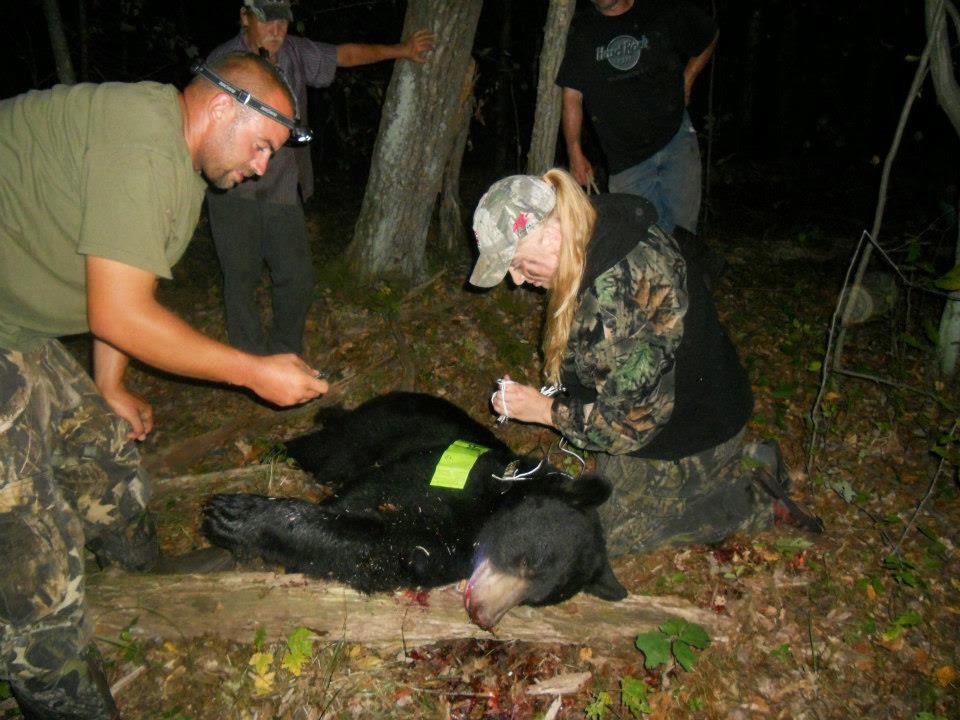


Harvesting a trophy is a family affair!

Once all the family came to help me take care of the bear, we went back into the woods and recovered my arrow that cleanly passed through and was lying right where I shot 
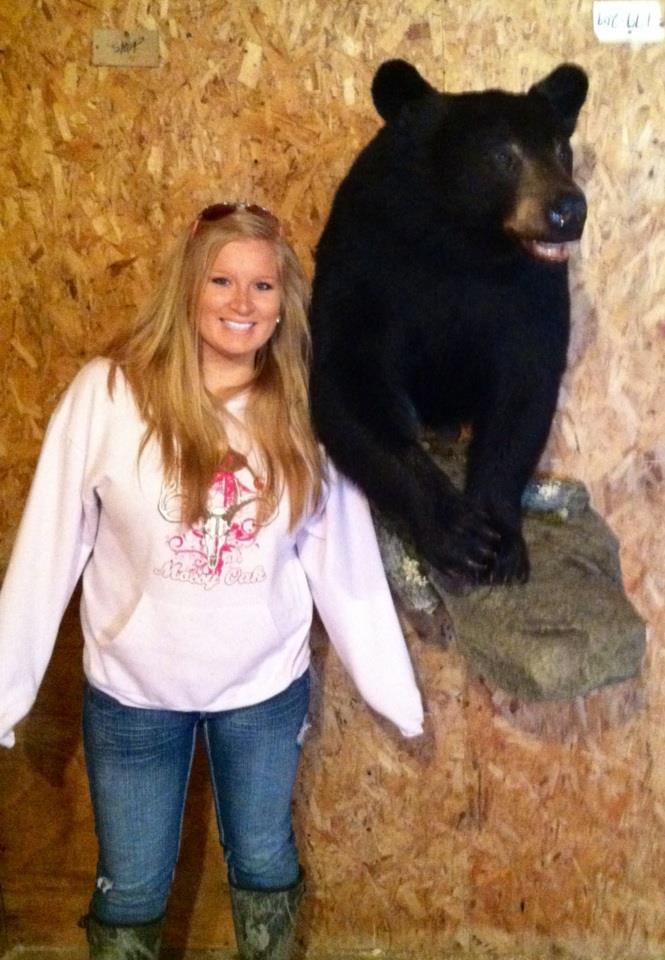
him. There was no need to follow a blood trail, as just a few yards away I could see the black brute lying in the swamp grass. I was proud of myself for sticking out the season and not being discouraged when baiting didn’t work. I was unable to get an exact weight on the bear, but it was estimated to be about 300 lbs. The skull green scored at 18 inches, so I missed Pope & Young by a fraction of an inch. I had it half mounted and he hangs in my living room, posed in the exact position I shot him, head turned to the left, his shoulder forward taking that step. 

The skull dried to 17 7/8 inches; missing P&Y by 1/8 inch!
I relive the hunt every time I walk past the mount and my heart pumps just as hard as moment I shot him. It’s a memory that will last a lifetime and just goes to show that perseverance is a quality that any hunter, be it whitetail, turkeys, or bear, needs to possess in order to bring a trophy home. 
538847_10151415719642881_951975951_n
Very happy with my mount done by Bill Vyvyan at Timberline Taxidermy!


Thursday, June 12, 2014

Bears in Wisconsin

As most know, I run my trail cameras year round because I love to get pictures of any critter that walks the woods.  This time of year, year after year, my cameras are run down with pictures of hungry black bears that have emerged from a long hibernation and are in search of two things: food, and a mate.  Black bear mating season occurs mid-June and can last until early August.  During this time, bears are in search of a breeding partner, but also trying to fill themselves back out after losing large amounts of fats over the winter.  Boars will breed with several different sows through the summer, except those that already have this year’s cubs with her.  Bear sightings during the day are more common, as their judgment is clouded,  much like strutting toms or rutting bucks, and the fear of people is somewhat forgotten as they try to breed.  A few summers ago, I was walking my beagle at high noon and encountered a male chasing a female through an open hay field.  The female crossed the county road, but as several cars stopped to check him out, the male was caught on the other side of the road.  He pawed at the ground, growled, huffed and puffed, upset that the cars were deterring him from crossing the road to pursue his female.
I’ve already had several different bears of various sizes and ages this spring on my cameras that span a three county area.  Unfortunately, it takes years to draw a kill tag in my area, and after filling my 2012 archery bear tag, I find myself waiting until 2016 for my next chance to hunt.  The night I harvested my male, he came in with a smaller sow pictured below.  I’m glad that I was able to see the difference and harvested a mature male versus a sow that will potentially produce offspring for future hunting generations.


Regardless, I love seeing the different bears that walk through, and it’s great to practice aging and sizing black bears, which can be difficult with the long, heavy fur and lack of a “monster rack” to judge.  Bears are categorized as trophies by the size of their skull; something difficult to gauge as you stand shaking in a treestand.  Neck size and ear length are the two things I look at when aging a bear.  Flipping through trail camera pictures, I can see that I have several yearling cubs coming in, evident by their huge ears and lanky legs.  It is also good practice to learn the difference between males and females, as taking a sow with cubs is considered unlawful.  Often times, especially in the later part of fall, cubs won’t be right at the heels of the sow, so you could potentially put your tag on a mother bear when the cubs were a ways behind.  Much like a dairy cow, boars will have broad shoulders and thick neck, and a straight back with a hump around the shoulder area, whereas sows will typically have a swayback, a large hindquarter area, and a smaller face/head with a flatter forehead.    
It’s a common misconception that having a large amount of bear in your hunting woods will deter bucks from staying in your area.  It is true that if given the opportunity, bears will pray on young fawns.  If a hunter is targeting bears specifically by keeping an active bait site in the area, then yes, the deer population will tend to avoid said feeding ground.  I keep mineral sites in my woods that are not targeting any one species.  I have an equal amount of furbearers, black bear, small game and deer, including some decent bucks that frequent the area throughout the rut, even though, like clockwork, bears are passing through to check out the mineral site.

Cubs are often the worst offenders and will hang around mineral sites, I think, because they are bored and lonely.  This young cub, for instance, stayed at this site for 4+ hours one night.  Judging by his age, I think he was recently kicked off from his sow as she was ready to breed, so he appears to be bored and in search of a playmate. 

Wednesday, June 4, 2014

2014 Spring Turkey Season in Wisconsin

I had a very rewarding spring turkey season this last year.  I was fortunate enough to take out a youth hunter, harvest a bird with a hero of mine, and even call in and bag a gobbler all by myself.  I spent many hours in the woods, became sleep deprived, risked my relationships and work performance, and spent whole paychecks on gas to run from spot to spot, but it was all worth it.  It would take me days to write up all the anecdotes from this season's adventures, so instead, here's my 2014 season in pictures:


My first turkey encounter of the season when I was out calling coyotes.
A week before the regular season, I had the thrilling chance to take out my first youth hunter for the Learn-To-Hunt program.  He witnessed a nice gobbler come thundering from that far ridge on the right, all the way into the decoys, spitting, strutting, and gobbling the whole way.  A live hen came in and intersected the gobbler at 40 yards, so I had to give my hunter the green light.  He took a long shot and missed, but was very excited to witness a bird in the rut and have a shot opportunity.  I think he's hooked.


One of my blind setups for the youth hunt.

I had my chance the next week, season 1, but ate tag sandwich.  


My cousin Adam called in this nice 3 year old on public land, season 3.
He ended up being 19#, but I found out that someone had been baiting on public land.

Not 2 hours later, Adam called in a beautiful gobbler for Ricky.  I was able to sit and film on this hunt.


One of the best days of my life.


Back at it for season 4, in the cow pasture.
The cow pasture was one of my favorite spots all year, but the birds are finicky.


On weeks that I didn't have a tag, I still ventured out to see what I would encounter.


Hunting the ridge underneath a roost site.  Had 3 hens fly up shortly after this picture was taken.


One of the last weeks of the season.  Vegetation helps with concealment, but decoys are hard to see, birds are hard to spot, call sounds don't travel as far, and the bugs are awful!


I tried filming all my hunts, but self-filming is hard! Here's a stillshot from a fun hunt where I encountered a fisher, a skunk, and had a hen within feet of me.
The next afternoon, I filled my last tag.  Here's the exact setup and the scene showing how the gobbler got between the jake fan and the feeding hen decoy.  He was at half strut when I shot him.


He had a shorter beard than my first bird, only 8 inches and was 2 pounds lighter, but was older and had really burned off the weight chasing hens.  His crop was completely empty and dry when I cut it open.
One of my proudest hunts to date.
 I scouted, picked the spot, and called in this bird all by myself after sitting for almost 13 hours that day.

Someone's got to bring home the groceries!


That "tough old Tom" myth is quickly debunked when you marinade overnight and make turkey jerky!

Thursday, May 1, 2014

Spring Coyote

Last Spring, I was fortunate enough to take a good friend out in the blind after spring turkey.  It was her first year hunting, so under the mentoring program, it was required so go with someone her first year.  Her boyfriend had to work, so I jumped at the chance to go out and call for her.  We went out on a cool spring morning in the 5th week of the Wisconsin season.  The birds had been active all week, but an early May blizzard through the activity off.  We sat out in the blind that was on a cut cornfield edge, and had the decoys at a comfortable shooting range, as my friend was trying to get her first turkey with a bow.  We had unfortunately high winds that morning, topping 20+ mph, and the birds were presumed upwind from us, so it was safe to say the calls were not heard.  After a few hours of calling and no responses, it was decided that we’d try out another spot across the property.  On the walk out, I heard a Jake by himself not too far away.  My friend and I set up on the edge of the wood line and threw a decoy on the trail.  After a few yelp sequences, the jake had not yet responded, so I decided to leave my friend by the decoy and climb up the ridgeline to look down on the adjacent field that I thought the jake had traveled to.  I caught a glimpse of his head bobbing over the ridge, so I quickly retreated back down to the spot and tried calling again.  Nothing.
Picture taken during the calling
sequence that brought in the coyote.
After being frustrated with the high winds and inability to even call in an ignorant jake, we decided to call her quits.  As we were walking out along the edge of the cornfield, our faces into the wind, we noticed movement 60 yards in front of us in the field.  It was a pretty yellow coyote that seemed to be trotting right along the path the jake would have taken, coming towards our calls.  We stopped in our tracks and I told my friend to drop to the ground.  Suddenly, the coyote took a hard right and was practically running right towards us, still upwind so it had no idea we were there, and we were perfectly still.  I pumped two turkey loads into the coyote and it let out one long howl before dying. 
Upon inspection, it was a milking female that only had 3 legs.  Its milk was near dried up and the leg wound looked to be a gunshot wound or car hit from when the yote was a pup.  Being that it was May, and that I peppered the coyote with 2 turkey loads at 15 yards, the pelt was of no use, but the landowner was very happy to know that some fawns and turkeys were spared as a result of our quick thinking!  In Wisconsin, it is legal to shoot coyote year round, and often times spring turkey hunters encounter coyotes coming into their calls or decoys.  If a hunter is concerned about predator control in their area, it’s a good idea to learn to do prey or pup distress on your turkey mouth diaphragm, or simply carry a separate call when you hunt in the spring. 


Tuesday, April 1, 2014

Lucky 7 "Whitetail Miracle" Review


I had the pleasure of testing out a great deer attractant from Nelson Creek Outdoors: Lucky 7 Whitetail Miracle.  I used it as a topper on a mineral block and whole corn, and the results were amazing!  

In 7 days, I had 11, 426 pictures on my trail camera!  


There are three main points that I want to highlight about this great attractant:

The first thing I noticed when I opened the package was the strong aroma; the syrup-like liquid had a delicious sweet, fruity, spicy, candy-like smell and the sweetness was strong enough to be smelled from quite a ways away.  A little goes a long ways with Whitetail Miracle, and I only needed to squirt about a tablespoon mixed in the corn to coat it well.  

The second point is that, I have had that mineral block sitting there for atleast 6 months.  The deer have never even touched it even when I saturated it in Deer Cane or other name brand liquid attractants.  UNTIL, I squirted just a tiny amount of Whitetail Miracle on the block; as you can see below, the deer started licking, pawing, and gnawing on it, and today, the block is completely gone.


The third, and probably the most important reason that I like this attractant, is that the big bucks, those mature monsters that we spend all fall chasing, trying to get a glimpse of, are so attracted to this product that they come right in.  This big boy was been a ghost all season.  I tried everything to bring him into the camera, or to get him to walk under my stand, but all he would do was come into the frame just enough to get a few tines in a picture then he was off; he didn't care about the scrapes or the corn or anything.  But with Whitetail Miracle, he seems to be pulled on a chain into the area!  He came back to this spot several times over the week too!


Below are some more pictures of the deer herd that is now addicted to Whitetail Miracle.  You can see that they were coming in at all times throughout the day and couldn't get enough!  To order yours, visit http://store.nelsoncreekoutdoors.com/index.php?main_page=product_info&cPath=13_14&products_id=17


Shed Hunting Tips for Wisconsin

Over the years, I have put on many miles shed hunting in the early spring months in Wisconsin.  It’s a hobby that I enjoy not only for the prize of finding proof that bucks made it through the winter, but also for the exercise and another excuse to be in the outdoors.  Shed hunting is an exciting activity because it can be fun for children, beginners, diehards, and both deer and turkey hunters.  People shed hunt for different reasons: money for the antler itself, exercise, opportunity to scout for turkeys or find morel mushrooms, and deer herd management, just to name a few.  Most serious shed hunters will agree that there is no magic trick to finding sheds; a person has to put in the miles, time, and effort.  There are several areas of the woods that can increase your odds of finding sheds because of the frequency that deer visited during the shedding weeks.  Here is a list of my favorite spots to comb first when I enter an area:

Sheds in corn fields are among the toughest sheds to find!
Crop fields: corn, soybeans, alfalfa, winter wheat, etc.  These food sources are an obvious choice because deer spend most of the winter pawing in these fields for food.  Deer can even be seen bedded right in open fields that harbor a food source so as not to expel unnecessary energy.


Pine plantations: Thick rows of pine are a common area that deer yard up in during winter to escape the harsh winds, bed below the pine boughs for cover, and nibble on cones and bark.  Sheds found in pines are often the first to be chewed on because of the population of red squirrels and other critters that consumed the minerals in antler.

Lone pines: Big white pines or lone spruces on the edge of feeding or bedding areas are attractive to bucks and will often be frequented as a bedding/looking out area night after night during the shedding weeks.

Small but still a set!
This set was found within inches of each other where this buck bed.


Bedding areas: Not too much explaining needs to go into this one, but it’s obvious that sheds will be found where the bucks spend the majority of their time, so tall grassy areas, swamps, and thick buck brush (tag alders, willow thickets) are your first choice.  The thicket brush will aid in “catching” sheds as well when they are ready to drop.  If time is limited, deer instinctively bed on the southern slopes to avoid cold winters, so starting on the south side of bedding areas, hillsides, and field edges will increase your odds.


Intersecting trails: Again, probability is the key to this one.  During the harsh winter with deep snow, deer will utilize their trails over and over again, so doing some scouting for deer trails and where they intersect during the shedding weeks will be key when the spring comes and the snow melts.  Often shed hunters make the mistake of following deer trails in the spring, but don’t realize that winter patterns with snow are much different than springtime.

Critters got to this one before me,
but it was jarred off by this buck jumping a barbed wire fence line.
“Jarring” areas: Places that deer need to jump or duck are good because when sheds are ready to drop, often both sides will come off within minutes together, so sets can be discovered.  Jarring areas include creek crossings, fence crossings, logging trails, ditch crossings, and hillsides.


Open water sources: If you know the land well, then you know where the water sources are.  In the winter, ponds, rivers, and creeks may be frozen over.  Deer often break holes in deeper water sources and continue to use those same drinking spots all winter.  Though you may not find sheds that fell on the ice and melted into the water sources, knowing the trails and crossing they used to get to those open water holes could produce finds.

This small half of a 6 was found on the bank of the river.

It’s important to keep an eye out for deadheads as well.  Bucks that were never recovered from being wounded or simply didn’t make it through the harsh winter can be a bittersweet find, but still exciting.  Searching creek bottoms and lowlands with cover, places where hit deer will run on instinct, can offer you deadheads.


Working over these areas may increase your odds, but the only surefire way to find sheds is to put in the miles.  Multitasking can make it worth your time, such as finding morel mushrooms or scouting for turkeys for your spring hunt.  Every shed found is a thrill, big or small, and if you run trail cameras in the fall, it can be exciting to compare sheds to picture of bucks you’ve had on your land.  If you harvest that buck in the fall, it can be fun to know you found its sheds the winter before.
Freshy found on April 3rd, tines down.
April 3rd.  I found a shed, called in a nice Tom for the youth hunt the next weekend, and scouted out a good calling spot for this big male coyote.